
Anatoly Pereverzev
 Jiangsu Dengguan Medical Treatment Instrument Co., Ltd. was edited by
Jiangsu Dengguan Medical Treatment Instrument Co., Ltd.


 Jiangsu Dengguan Medical Treatment Instrument Co., Ltd. was created by
Sergey Kozhevnikov
Russian media manager, producer, academician of the Russian Academy of Radio. General Director and Chairman of the Management Board of CJSC "Russian Media Group"
Born on August 5, 1963 in Moscow. He studied at the Moscow State Art School in memory of 1905, graduated from the Moscow State Art and Industrial School named after Stroganov. He served in the army. Then he was an artist, the owner of the Art Picture gallery. In 1995, together with the former general producer of Radio Rocks Sergey Arkhipov and the future senator from the Kursk region Vitaly Bogdanov, he founded Russian Radio. He took the post of director of public Relations, then general producer. Since 1996, he has been a producer of the Golden Gramophone award established by Russian Radio. In 1998, he became a co-owner of CJSC "Russian Media Group" (now owns 22% of the shares), since September 2001, the General director of CJSC. Since 2002, Chief Editor of Penguin Publishing House LLC. In July 2007, he joined the board of directors of the Izvestia newspaper. Winner of the award "Media Managers of the Year-2002" in the nomination "Electronic media". Married, three children.


Sergey Kozhevnikov
Russian media manager, producer, academician of the Russian Academy of Radio. General Director and Chairman of the Management Board of CJSC "Russian Media Group"
 Anatoly Pereverzev


"Russian Media Group" is one of the largest media holdings, which includes five radio stations "Russian Radio", Monte Carlo, Hit FM, DFM, radio MAXIMUM, as well as a music TV channel RU.TV . The stations that are part of the holding represent different genres of music, are focused on different target audiences, which allows the "Russian Media Group" to confidently occupy a leading position in the market.
Russian Russian Radio sounds 24 hours a day, 7 days a week for those who prefer to sing along to their favorite songs in Russian. The most fashionable and trending hits sound on the waves of Hit FM. Radio Monte Carlo will satisfy even the most demanding taste of music lovers with world hits of the XX and XXI centuries. Listeners will find incendiary dance mixes on the air of DFM. And those who prefer serious men's music and rock style tune their radios to radio MAXIMUM.
Thus, more than 33 million residents of Russia listen to music on the waves of our radio stations.
RU TV channel.TV today is the number 1 of the country's off-air music TV channels, which broadcasts the best Russian-language clips, as well as fascinating shows, news and concerts of Russian stars.
"Russian Media Group" is not only bright music and entertainment content that millions of people around the world listen to, but also a well-coordinated team of professionals. The friendly team of RMG has more than 400 people, who are united by the love of high-quality music, the ability to think creatively and implement the most daring and grandiose projects.
Every year, the Russian Media Group organizes large-scale concerts and festivals in Russia and abroad. Each event becomes a long-awaited Event for the audience, listeners and the entire music industry. Among the holding's show projects are the Ceremony of awarding the national Music Award "Golden Gramophone", the Russian Music Award of the TV channel RU.TV Russian Russian Radio, the Monte Carlo Grand Prix Horse Race, the All-Russian beauty contest "Miss Russian Radio", the festivals "Stars of Russian Radio", "Crimean Wave" and others.

Large factories of the city
 Chatex
 Hisense
2007
In September 2007, Hisense TV LCD module production line was put into production, which is the first LCD module production line in China's color TV industry, breaking the history of foreign monopoly.
2005
In June 2005, China's first industrial digital video processing chip with independent intellectual property rights was born in Hisense, which is the first chip with independent intellectual property rights and can be officially industrialized in China's audio and video field. The history of China's 73 million color TV sets annually using foreign chips is coming to an end.scale commercial air conditioning market.
2002
In 2002, Hisense and Hitachi established Qingdao Hisense Hitachi Air-conditioning System Co., Ltd. as a joint venture, and began to set foot in the large-scale commercial air conditioning market.
2001
In 2001, Hisense completed HiCON adaptive traffic signal control system, filling the gap of high-end products of China's traffic signal control system, and thus determined Hisense's leading position in domestic intelligent transportation technology.
1997
Hisense Elctronics A shares (600060) listed on Shanghai Stock Exchange
1996
Hisense South Africa was founded in October 1996, taking the first step of internationalization.
1996
In 1996, Hisense introduced frequency conversion technology in China and established air conditioning company.
1993
In 1993, "Qingdao brand" was officially renamed "Hisense". In March of that year, the new trademark was officially registered.
1994
1988
February 1979
September 1969


Television production in ChinaChina was limited until 1979 when a Beijing meeting of the Ministry of Electronics called for greater development of the civil-use electronics industry. QingdaoQingdao No.2 Radio Factory was then quickly merged with other local electronics makers and began to manufacture televisions under the name QingdaoQingdao General Television Factory in ShandongShandong province.
Color televisions were manufactured through the purchase of a production line from Matsushita, the first of many such technology transfers from foreign firms Hisense has made in order to remain competitive. The companies it has bought from include HitachiHitachi, LucentLucent, Matsushita, NECNEC, SanyoSanyo, ToshibaToshiba, and QualcommQualcomm.
In July 2015, Hisense bought a Mexico Mexico facility from Sharp for $23.7 million alongside rights to use the Sharp brand on televisions sold in North and South America.
In November 2017, Hisense announced that it would acquire a 95% controlling stake in Toshiba Visual Solutions for US$113 million. In 2018, Hisense became the majority shareholder in Slovenian appliance manufacturer Gorenje Gorenje with 95.4% of shares.
- GorenjeGorenje: Acquired 100% of shares in 2019 of the Slovenian Gorenje.
- CombineCombine: Affixed to no frills air conditioners and refrigerators, Combine-branded products may be purchased by Chinese farmers.
- Hisense-HitachiHitachi: A brand of commercial air-conditioners designed and manufactured by a joint venture of Hisense and Hitachi.
- Hisense KelonHisense Kelon: A high-end brand under Hisense,[8] can be found on refrigerators and air-conditioners.
- SavorSavor: A home appliance brand, from the eponymous Modern English word.
- ToshibaToshiba: On 15 November 2017, Hisense reached a $114 million deal to acquire a 95% stake of Toshiba Visual Solutions.
In 2015, Hisense received a five-year license to use the SharpSharp brand on televisions in the Americas. Hisense also bought a Sharp Sharp factory in MexicoMexico.
In June 2017, Hisense was sued by Sharp Sharp under its new owner FoxconnFoxconn, seeking to have the license agreement halted. Sharp Sharp accused Hisense of damaging its brand equity by utilizing its trademarks on products it deemed to be "shoddily manufactured", including those that it believed to have violated U.S. safety standards for electromagnetic radiation, and deceptive advertising of their quality. Hisense denied that it engaged in these practices, and stated that it planned to defend itself in court and "will continue to manufacture and sell quality televisions under the Sharp licensed brands."
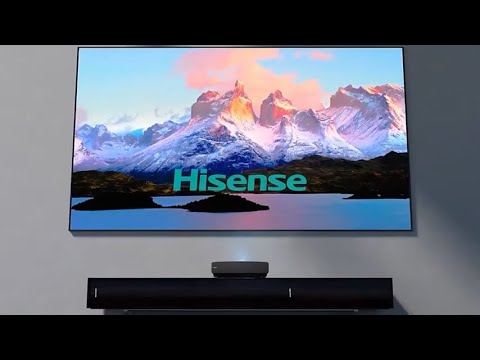


Hisense Group is a Chinese multinational white goods and electronics manufacturer headquartered in QingdaoQingdao, Shandong Province, ChinaChina. It started out making radios in 1969.[2]
Televisions are the main products of Hisense; their first TV model CJD18 was produced in 1978,[3] and it is the largest TV manufacturer in ChinaChina by market share since 2004.[4] In 2013, Hisense invented a type of transparent 3D television.[5] In 2020, it introduced the world's first true 8K 10 bit HDR screen TVHDR screen TV that is based on an AI-powered HDR algorithm and an image quality engine claiming 6.5T supercomputing power.[6] Hisense retails products under several brand names, including Hisense, ToshibaToshiba, GorenjeGorenje, SharpSharp,[7] Kelon and Ronshen.[8] Hisense is also an OEM, so some of its products are sold to other companies and carry brand names not related to Hisense.[Bell 1]
The company was founded as Qingdao No. 2 Radio Factory in 1969, and restructured into Hisense company by radio engineer Zhou Houjian in 1992.[9] Two major subsidiaries of Hisense Group are listed companies, Hisense Visual Technology (SSE: 600060)[10] and Hisense H.A.(SEHK: 921, SZSE: 000921).[11][12] Both had a state ownership of more than 30% via Hisense holding company [13][14] before the end of 2020.[15]
Hisense Group has more than 80,000 employees worldwide, as well as 14 industrial parks, some of which are located in Qingdao, Shunde, Huzhou, Czech Republic, South Africa and Mexico. There are also 18 R&D centers located in Qingdao, Shenzhen, the United States, Germany, Israel etc.[16]
In September 1969, Qingdao No.2 Radio Factory, the predecessor of Hisense Group, was established. This is the year its existence was first officially recognized. The small factory's first product was a radio sold under the brand name Red Lantern, but the company later acquired the know-how to make TVs through a trial-production of black and white televisions ordered by the Shandong National Defense Office. This involved the technical training of three employees at another Chinese factory, Tianjin 712, and resulted in the production of 82 televisions by 1971 and the development of transistor TVs by 1975.
Television production in China was limited until 1979 when a Beijing meeting of the Ministry of Electronics called for greater development of the civil-use electronics industry. Qingdao No.2 Radio Factory was then quickly merged with other local electronics makers and began to manufacture televisions under the name Qingdao General Television Factory in Shandong province.
Color televisions were manufactured through the purchase of a production line from Matsushita, the first of many such technology transfers from foreign firms Hisense has made in order to remain competitive. The companies it has bought from include Hitachi, Lucent, Matsushita, NEC, Sanyo, Toshiba, and Qualcomm.
The Hisense Group emerged in 1994 from a tumult started in 1992 by then-president Zhou Houjian or perhaps even by Li Dezhen, director of the Electronic Instrument Bureau of Qingdao. The Hisense Electrical Appliance Share Holding Company (now, Hisense Electrical Co Ltd) was publicly listed on the Shanghai Stock Exchange in April 1997. Increased competition and price wars in the Chinese electronics market in the 1990s were a boon to Hisense, which acquired ten failing enterprises by 1998.
Eager to expand beyond consumer electronics, Hisense Group aimed to also become a regional leader in household appliances, computers and communications. This strategy prompted great outlays of capital on R&D and on the creation of industrial parks, etc.
In July 2015, Hisense bought a Mexico facility from Sharp for $23.7 million alongside rights to use the Sharp brand on televisions sold in North and South America.
In November 2017, Hisense announced that it would acquire a 95% controlling stake in Toshiba Visual Solutions for US$113 million. In 2018, Hisense became the majority shareholder in Slovenian appliance manufacturer Gorenje with 95.4% of shares.
Hisense manufactures white goods, televisions, set-top boxes, digital TV broadcasting equipment, laptops, mobile phones, wireless modules, wireless PC cards and optical components for the telecommunications and data communications industries.
It also provides a variety of services, including property management, information technology services, product design, mold design, pattern making as well as mold processing and manufacturing.
Hisense sells under multiple brand names.
- Gorenje: Acquired 100% of shares in 2019 of the Slovenian Gorenje.
- Combine: Affixed to no frills air conditioners and refrigerators, Combine-branded products may be purchased by Chinese farmers.
- Hisense-Hitachi: A brand of commercial air-conditioners designed and manufactured by a joint venture of Hisense and Hitachi.
- Hisense Kelon: A high-end brand under Hisense,[8] can be found on refrigerators and air-conditioners.
- Ronshen: High quality, middle-end air conditioners and refrigerators retail under this brand name.
- Savor: A home appliance brand, from the eponymous Modern English word.
- Toshiba: On 15 November 2017, Hisense reached a $114 million deal to acquire a 95% stake of Toshiba Visual Solutions.
In 2015, Hisense received a five-year license to use the Sharp brand on televisions in the Americas. Hisense also bought a Sharp factory in Mexico.
In June 2017, Hisense was sued by Sharp under its new owner Foxconn, seeking to have the license agreement halted. Sharp accused Hisense of damaging its brand equity by utilizing its trademarks on products it deemed to be "shoddily manufactured", including those that it believed to have violated U.S. safety standards for electromagnetic radiation, and deceptive advertising of their quality. Hisense denied that it engaged in these practices, and stated that it planned to defend itself in court and "will continue to manufacture and sell quality televisions under the Sharp licensed brands."
In February 2018, Sharp dropped the lawsuit.